Each vehicle has its own separate schedule, which starts over after the last task is completed.
¶ The schedule can be disabled when:
¶ Icons
¶ Task Types
¶ Rest
If we set a rest period, the car will wait a specified number of hours, but the driver will receive more morale than if the car were just parked in the garage. The number of morale points the driver receives depends strictly on the number of hours.
The formula for the number of points received is the sum of the following numbers:
1 hour = 1 point
2 hours = 3 points = 1 + 2
3 hours = 6 points = 1 + 2 + 3
4 hours = 10 points = 1 + 2 + 3 + 4
5 hours = 15 points = 1 + 2 + 3 + 4 + 5
6 hours = 21 points = 1 + 2 + 3 + 4 + 5 + 6 etc.
Remember that the driver still receives +4 points per hour, regardless of whether they are on the road, resting, or not assigned to a car.
¶ Examples of the best configuration
¶ A setup without flaws
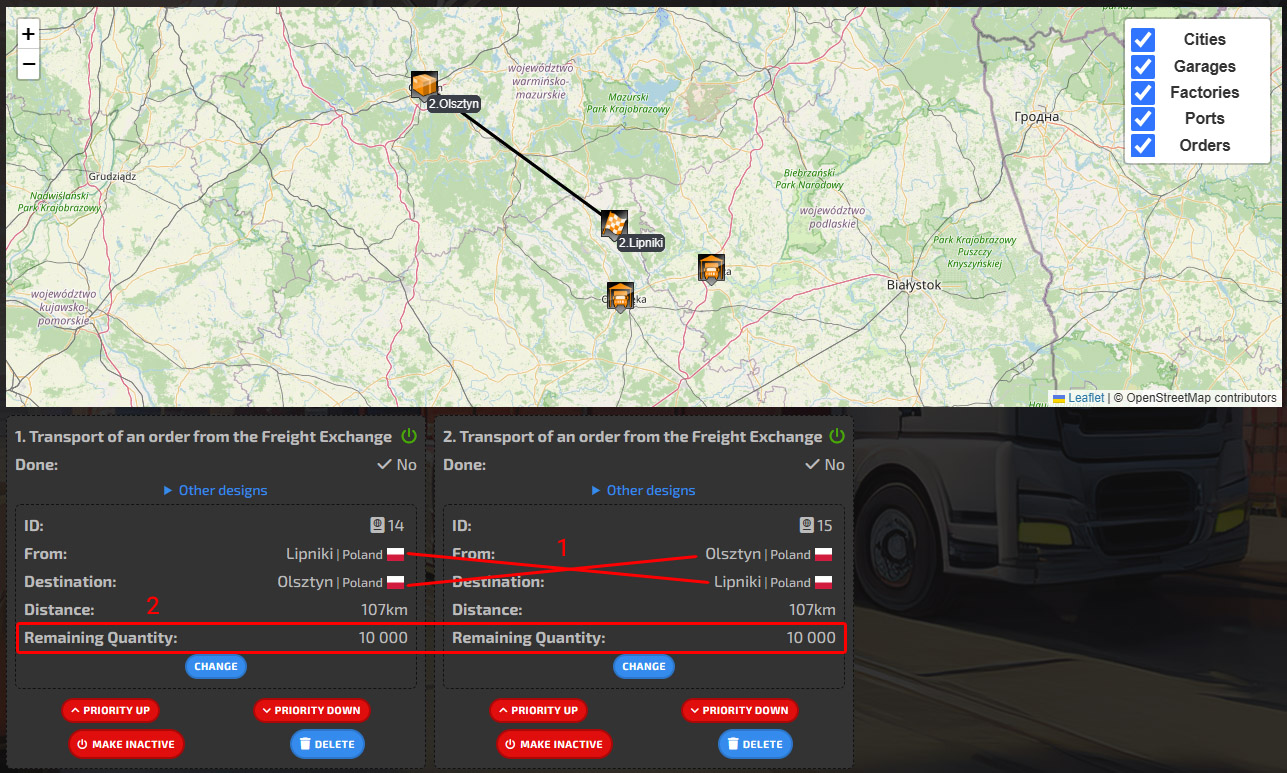
Why is this setup the most optimal?
1. Zero empty runs - the routes perfectly overlap, the first ends where the second begins and the second ends where the first begins
2. The quantities are the same - thanks to this, they will end at the same time, when there are different schedules, it will end work when one of them is finished
A vehicle with a capacity of 1,000 will complete this plan in 10 loops, i.e. 20 trips (Lipniki → Olsztyn then Olsztyn → Lipniki), earning money each time.
Of course, we do not have to create only two routes, we can combine them as many as we want:
¶ Schedule with a small inlet
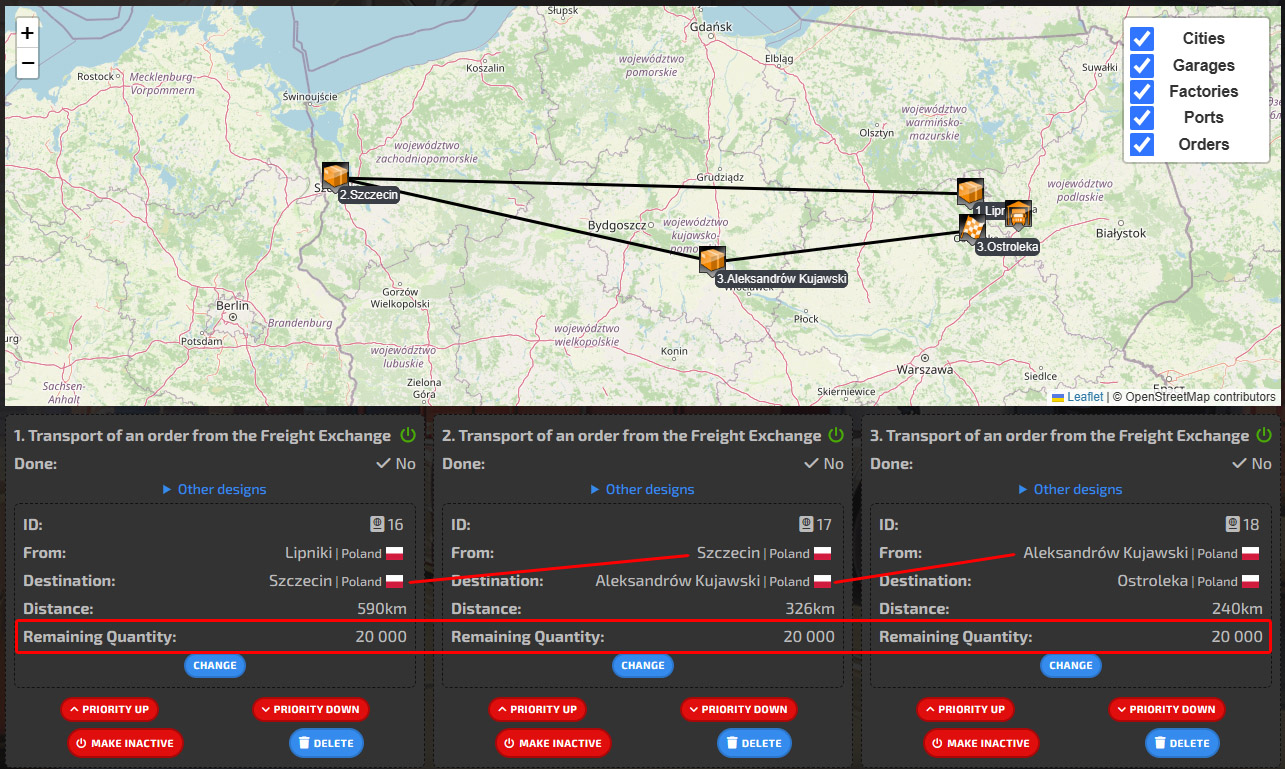
Disadvantage: Empty flight between the last dispatch and the first, the vehicle will have to make an empty trip from Ostrołęka to Lipniki.
Advice: In order for the vehicle not to make an empty flight, it is worth adjusting the order, in the filters on the exchange (or in the company's city orders) we provide the starting and ending city (only one each), we provide the type of load and the size we need, then the order will be shown to us, the disadvantage of this is a much lower payment, but it is better than an empty flight